




Love stories have always deserved symbols worthy of their depth — and for generations, that symbol has been a diamond ring. But something interesting is happening in the world of fine jewelry. More couples today are stepping away from tradition not because they value commitment any less, but because they have discovered something that arguably sparkles even brighter. Moissanite engagement rings have moved from niche alternative to mainstream choice, capturing the hearts of modern couples who want beauty, brilliance, and meaning without the weight of outdated conventions. Whether you are just beginning your ring search or reconsidering what you thought you wanted, unique moissanite engagement rings offer a compelling case for why this gemstone deserves serious consideration.
What Exactly Is Moissanite?
Before diving into why moissanite has become such a beloved choice, it helps to understand what it actually is. Moissanite was first discovered in 1893 by French chemist Henri Moissan, who found microscopic particles of the mineral inside a meteor crater in Arizona. He initially believed he had found diamonds, but further analysis revealed something entirely different — silicon carbide crystals with optical properties unlike anything else on Earth.
Natural moissanite is extraordinarily rare, found only in trace amounts in meteorites and certain rock formations. Nearly all moissanite used in jewelry today is lab-created, which is precisely why it is both accessible and ethically appealing. The process of growing moissanite in a controlled laboratory environment produces a gemstone that is chemically, physically, and optically identical to its natural counterpart.
The Brilliance Factor: Where Moissanite Outshines Expectations
If you have ever seen moissanite in person, you already know it has a presence that is difficult to ignore. One of the most frequently cited reasons people fall in love with this gemstone is its fire — a term used in the gem world to describe the way a stone disperses light into spectral colors.
Moissanite has a refractive index of 2.65 to 2.69, compared to a diamond’s 2.42. In practical terms, this means moissanite disperses light with more intensity, producing that rainbow-like sparkle that catches the eye from across a room. Under natural light, indoor lighting, or candlelight, moissanite performs beautifully in every environment.
For couples who want a ring that commands attention and holds its visual presence over decades, this optical quality is one of moissanite’s most convincing selling points.
Durability You Can Count On
An engagement ring is not a piece of jewelry you wear occasionally — it is something most people wear every single day for the rest of their lives. Durability, therefore, is not a secondary concern. It is essential.
Moissanite ranks at 9.25 on the Mohs hardness scale, making it the second hardest gemstone used in jewelry, surpassed only by diamonds at 10. This means moissanite is exceptionally resistant to scratching, chipping, and the general wear that comes with daily use. Unlike softer stones that can dull or develop surface damage over years of wear, moissanite maintains its brilliance and structural integrity for a lifetime.
This durability makes moissanite engagement rings a genuinely practical choice — not just a budget-conscious one.
The Ethical Dimension
For a growing number of couples, the story behind a gemstone matters just as much as how it looks. The diamond industry, despite significant improvements in recent years, still carries complex ethical concerns related to mining practices, environmental impact, and supply chain transparency.
Moissanite sidesteps these concerns almost entirely. Because it is lab-created, there are no mining operations, no displaced communities, and no environmental destruction associated with its production. Couples who prioritize conscious consumption find that choosing moissanite aligns their ring with their values — and that alignment adds a layer of meaning that goes far beyond aesthetics.
Unique Designs That Reflect Individual Love Stories
One of the most exciting aspects of the growing moissanite market is the extraordinary range of designs now available. Long gone are the days when alternative gemstones were limited to basic solitaire settings. Today, unique moissanite engagement rings come in an astonishing variety of cuts, settings, and styles that allow couples to find something genuinely personal.
Popular cuts for moissanite include:
- Round brilliant — the classic choice that maximizes the stone’s natural fire
- Oval cut — elongating and elegant, flattering on a wide range of hand shapes
- Cushion cut — soft-edged and romantic, with a vintage-inspired quality
- Pear shape — distinctive and bold, perfect for those who want something unconventional
- Emerald cut — sophisticated and geometric, emphasizing clarity over sparkle
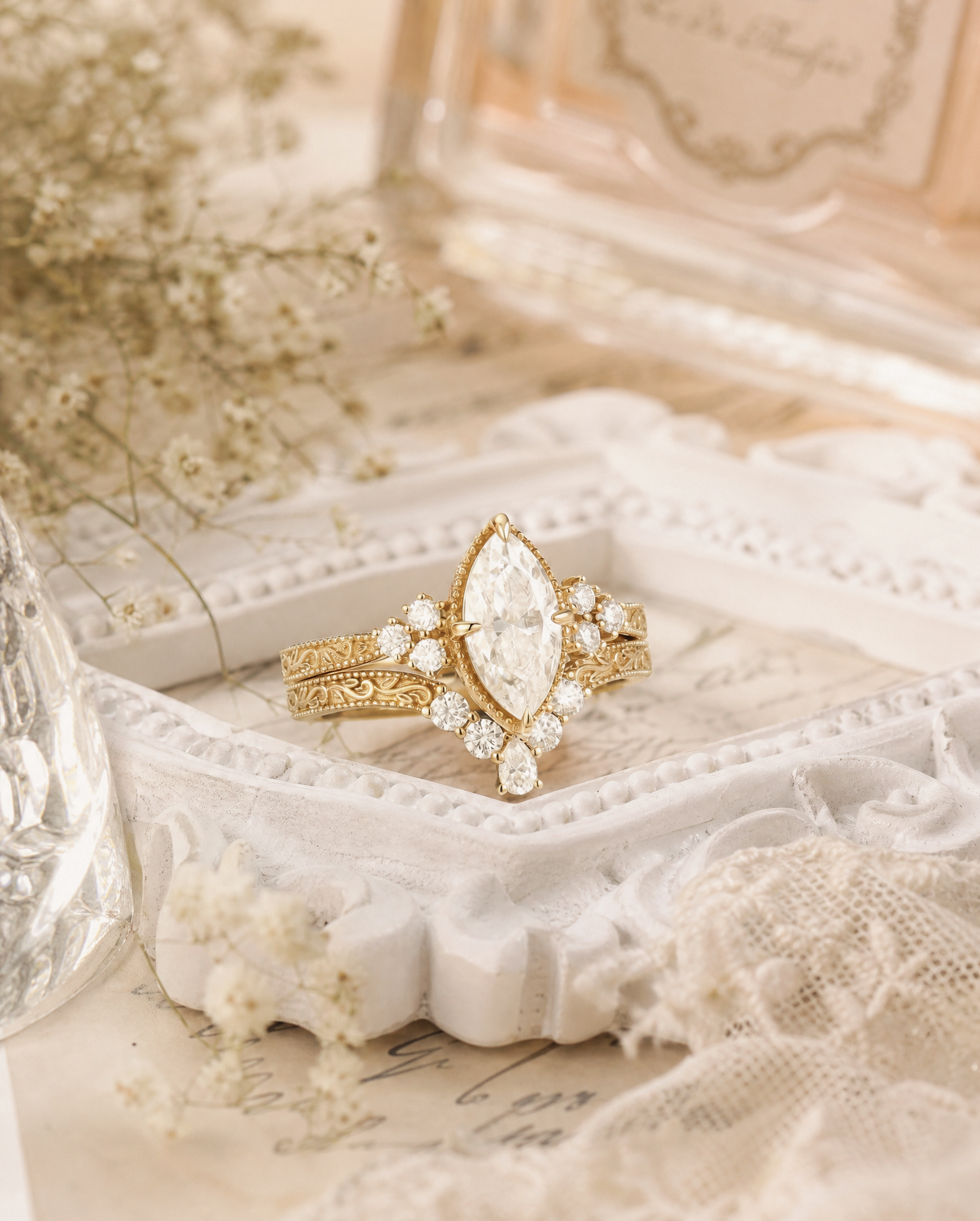
- Marquise cut — dramatic and elongated, with a regal quality that stands apart
Beyond the cut itself, setting styles range from delicate solitaires and pavé bands to elaborate halo designs, vintage-inspired filigree work, and nature-inspired motifs featuring leaves, vines, and floral elements. The variety available today means couples are not choosing between beauty and uniqueness — they can have both.
The Value Equation
Let us talk honestly about cost, because it is one of the most practical reasons moissanite has become so popular. A high-quality moissanite stone typically costs a fraction of a comparable diamond — sometimes as little as ten to fifteen percent of the diamond price for a stone of similar size and appearance.
This does not mean moissanite is cheap. Premium moissanite, especially in larger carat weights and higher-grade cuts, is still a meaningful investment. But the value proposition is undeniable: you can purchase a stunning, ethically made, highly durable gemstone and allocate the remaining budget toward a more elaborate setting, a matching wedding band, a honeymoon, a home, or simply financial stability as a couple.
For many modern couples who are already navigating significant financial milestones, this practical flexibility is genuinely meaningful.
Is Moissanite “As Good” as a Diamond?
This is the question that lingers for many people, and the honest answer is that it depends entirely on what you value. If what you value is geological rarity and the cultural legacy of diamonds, then moissanite is different — not better or worse, simply different.
But if what you value is brilliance, durability, ethical origin, design freedom, and long-term wearability, then moissanite engagement rings do not merely compete with diamonds. In several meaningful categories, they actually surpass them.
More couples are arriving at the conclusion that the “best” engagement ring is not defined by tradition or price tag, but by how well it reflects who they are as people and what they genuinely value as a couple.
Final Thoughts
The rise of unique moissanite engagement rings is not a trend driven by compromise. It is a movement driven by intentionality. Modern couples are asking better questions about where their jewelry comes from, what it truly represents, and whether the symbols they choose actually align with the life they want to build together.
Moissanite answers those questions beautifully — with fire, with integrity, and with the kind of lasting brilliance that has nothing to do with how much something costs and everything to do with what it means.
Written by: Anil Baswal